

Porcelain and silver, or silver plated, are both traditional teapots in England. One should note that these teapots are not designed for direct heat, due to the possibility of melting or cracking. But what are the pros and cons of these two types of teapots?
Silver is a precious metal, and as such tends to be very expensive. Being metal, it will also pull heat away from the tea and leak it into the air quite readily, which might be better for a summer day, but will lead to problems should you wish to use the pot for an extended amount of time in a cold winter. On the positive side, silver is supposed to react with the water, leaking minerals into the tea improving its taste. However, another down side of silver is its natural desire to tarnish. It should be kept well maintained and polished to prevent it from tarnishing. A good way to polish silver is to use an old tooth brush and a little bit of tooth paste.
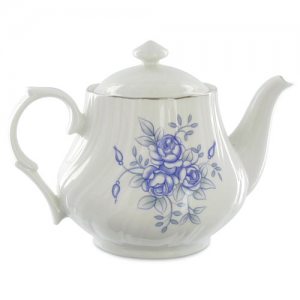
Porcelain teapots are very prone to staining, especially when being used for black tea. And depending on the design of your teapot, it may be very hard to clean out the inside, especially if you have large hands such as myself. But on the positive side porcelain is flavor neutral. As such, it is best at showcasing your tea exactly in how it itself tastes, smells, and appears. Porcelain in an unpainted form, showcases the color of the tea in an unbiased manner. Being a ceramic, porcelain is also better at holding onto heat, but that is also dependent on its thickness. And being glazed ceramic, the glaze might crack over time, leading to a crackled effect.
So these are some of the positive and negative aspects of porcelain and silver teapots. Both are useful, and both offer a distinctly European or English style tea. A teapot is nearly an essential part in the presentation and will certainly class up your tea.
[Editor’s note: Our blog is chock full of great articles on this topic. Use our search feature to find them!]
© Online Stores, Inc., and The English Tea Store Blog, 2009-2014. Unauthorized use and/or duplication of this material without express and written permission from this article’s author and/or the blog’s owner is strictly prohibited. Excerpts and links may be used, provided that full and clear credit is given to Online Stores, Inc., and The English Tea Store Blog with appropriate and specific direction to the original content.

 Tea Blog
Leave a comment