
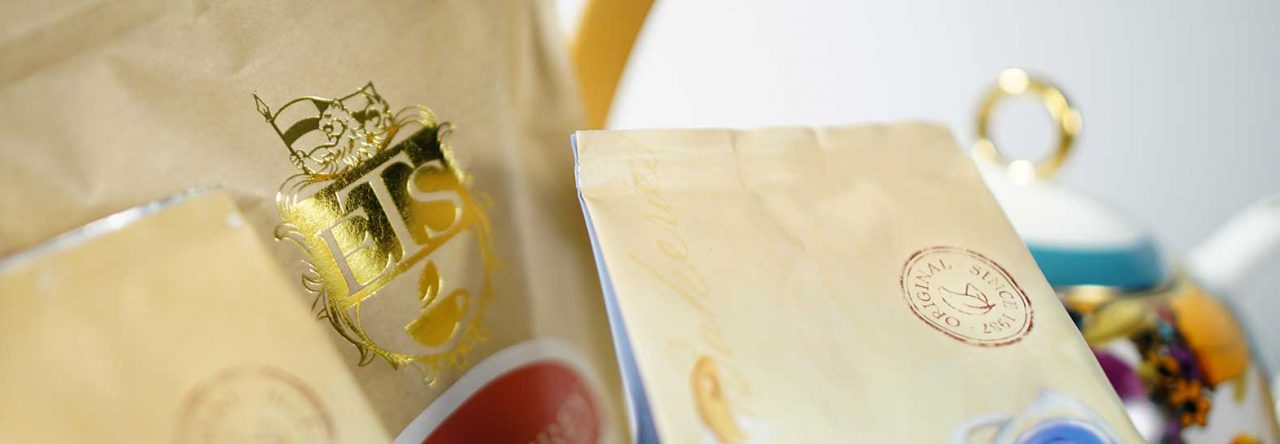
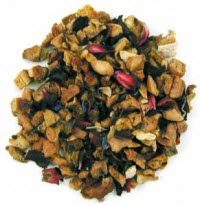
Blue Eyes Herbal “Tea” (Photo source: The English Tea Store)
In tea-related forums and discussion groups, one debate appears again and again: should the word “tea” be reserved strictly for beverages made from the Camellia sinensis plant, or is it acceptable to use the term for any infusion made in water?
This disagreement rarely reaches a conclusion. Many tea purists insist that only products derived from Camellia sinensis should be called “tea.” Others feel it is perfectly acceptable to refer to herbal infusions as “herbal teas,” fruit blends as “fruit teas,” and so on—even extending the term to powdered or instant beverages.
As someone who leans toward the “only tea is tea” viewpoint, I found it fascinating to discover that this linguistic ambiguity is not limited to English.
In German, for example, the word Tee is used much like “tea” in English. It applies to true tea, as well as to herbal and fruit infusions (Kräutertee, Früchtetee, etc.).
In Thai, a similar pattern appears. While “chaa” refers to tea from Camellia sinensis, the same word is used in phrases such as “roselle tea” for herbal beverages.
Curious about the origins of this usage, I turned to Chinese—the birthplace of tea culture. Surprisingly, the same flexibility exists. The word “chá” (茶) refers to tea, yet combinations such as 草药茶 (cǎoyàochá, herbal tea) and 菊茶 (júchá, chrysanthemum tea) are also commonly used.
This raises an interesting question: did Western languages adopt this dual usage from Chinese, or did Chinese evolve in response to global trade and linguistic exchange?
While answering that fully requires deeper linguistic expertise, we can see clear differences across European languages.
Languages such as French, Spanish, and Italian tend to distinguish more clearly between true tea and other infusions:
- French: “thé” (tea) vs. “tisane” or “infusion”
- Spanish: “té” vs. “infusión de hierbas”
- Italian: “tè” vs. “tisana” or “infuso”
Meanwhile, English and German—rooted in Germanic language families—use the same term for both tea and herbal infusions.
This suggests that the ambiguity surrounding the word “tea” may stem from deeper linguistic and historical roots, rather than simple misuse.
Of course, none of this resolves the ongoing debate. But it does provide a broader perspective—one that places the discussion within a cultural and linguistic context.
Perhaps the real question isn’t whether the term “tea” is right or wrong—but where, and when, the distinction first began to blur.
See more of Thomas Kasper’s articles here.
© Online Stores, Inc., and The English Tea Store Blog. Unauthorized use is prohibited. Excerpts allowed with proper credit.


 Tea Blog
Leave a comment